


Choosing a Recycling Facility Truck Dumper
July 9, 2026
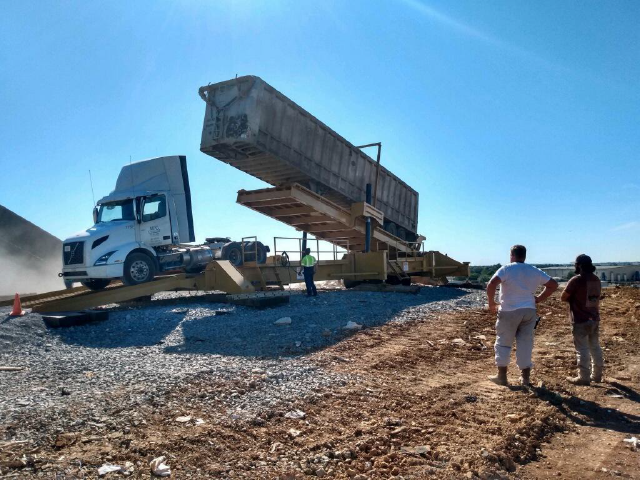
At a busy materials recovery operation, the truck is rarely the bottleneck. The delay usually starts at the point of discharge - when mixed recyclables, residual waste, wood waste, or baled scrap do not unload cleanly, quickly, or safely. A recycling facility truck dumper is built to solve that problem by turning inbound loads into controlled, repeatable material flow that matches the pace of downstream processing.
For plant managers and engineers, that decision is not just about lifting a truck. It is about throughput, containment, floor space, operator exposure, maintenance access, and how the dumper performs with the actual material stream coming through the gate. In recycling, those details matter more than brochure capacity.
What a recycling facility truck dumper needs to do
In simple terms, a truck dumper raises a truck, trailer, or container to discharge bulk material into a hopper, bunker, or receiving area. In a recycling facility, that sounds straightforward until the material itself starts changing by the hour. One load may be light, fluffy commingled recyclables. The next may be wet organics, shredded paper, construction debris, or compacted scrap with uneven weight distribution.
That variability is why recycling applications often need more than a standard dumping platform. The equipment has to handle inconsistent payloads, shifting centers of gravity, contamination, and impact loading from material that does not flow uniformly. A poorly matched dumper can create bridging in the hopper, leave significant carryback in the trailer, or force operators into repeated repositioning cycles that slow the line and increase risk.
A well-engineered system addresses those issues with the right deck geometry, cylinder arrangement, structural reinforcement, and discharge angle. It also accounts for the receiving system below. If the hopper opening, sidewalls, or live floor cannot accept the dumped material efficiently, the dumper alone will not fix the problem.
Why unloading design matters in recycling facilities
Recycling plants operate under a different set of pressures than many bulk commodity sites. Material is often lower density, less predictable, and more prone to hang up. Inbound traffic can be high volume, especially when transfer trucks arrive in short windows. Housekeeping is also a bigger issue because loose material can escape during unloading and create safety and fire concerns.
That makes unloading system design a production issue, not just a convenience. When the truck dumper is properly integrated, the facility gains faster turn times, more consistent feed to sorting or processing equipment, and less dependence on manual intervention. When it is undersized, overcomplicated, or mismatched to the payload, the plant pays for it through downtime, labor, cleanup, and equipment stress.
There is also a safety dimension that should not be minimized. Manual unloading support, suspended loads, unstable trailers, and repeated truck movement in confined areas all add exposure. Hydraulic dumping systems reduce much of that variability when they are designed with proper restraints, controls, structural margins, and operator visibility in mind.
Key engineering considerations for a recycling facility truck dumper
The first question is load type, not rated capacity. Capacity matters, but payload character often drives the design more than gross weight alone. Mixed recyclables can shift quickly. Scrap or C&D material can load unevenly. Wet waste can create sticky discharge conditions. Each of those behaviors affects deck sizing, frame design, lift angle, and hopper interface.
Truck and trailer configuration comes next. A facility receiving end dumps, live floor trailers, transfer trailers, roll-off containers, or straight trucks may require different dumping arrangements or a custom platform layout. The dimensions of the wheelbase, axle spacing, overall vehicle length, and discharge pattern all influence whether a standard truck dumper will fit the application.
Hydraulic system design is equally important. Cylinder sizing, hydraulic pressure, power unit configuration, and cycle speed should be matched to the duty cycle of the operation. Faster is not always better. In some recycling environments, controlled lifting and discharge improve material flow and reduce shock loading into the receiving hopper. A system that cycles aggressively but causes impact damage downstream may cost more over time than one built for steady, controlled operation.
Structural durability is another area where industrial buyers should look closely. Recycling facilities are harsh environments. Dust, abrasion, moisture, corrosion, and repeated heavy cycling all affect equipment life. Heavy-duty steel construction, reinforced pivot points, quality fabrication, and accessible service points matter because these systems are expected to operate for years under demanding use.
Controls should also fit the operating environment. Some facilities need straightforward local controls with simple operator training. Others need interlocks, remote operation, sequencing with hoppers or conveyors, or integration into plant control systems. The right answer depends on staffing, traffic flow, and the level of automation in the facility.
Standard equipment versus custom truck dumper design
Some recycling operations can be served effectively by a proven standard dumper design with application-specific adjustments. That is often the most efficient path when the inbound vehicle types are consistent and the receiving area is already established. Standardization can simplify maintenance, improve lead times, and reduce engineering complexity.
Other facilities need custom design because the constraints are real. Low overhead clearance, unusual trailer lengths, existing pit dimensions, special containment requirements, and difficult materials can all justify a tailored solution. In those cases, customization is not an upgrade for its own sake. It is what allows the equipment to work safely and productively in the actual plant layout.
For many buyers, the right approach falls between those extremes. A base dumper platform may be modified with a custom deck length, hopper arrangement, truck restraint package, cylinder configuration, or power unit layout. That kind of application-specific engineering is often the most practical way to improve unloading performance without redesigning the entire receiving line.
Integrating the dumper with hoppers and downstream systems
A recycling facility truck dumper should never be evaluated in isolation. The hopper, metering equipment, conveyors, and processing line all determine whether unloading gains translate into real throughput.
If the hopper is too small, trucks will still wait. If the feed system cannot meter bulky or tangled material, the dumper may discharge faster than the line can process. If sidewalls are too low or the drop height is poorly managed, material loss and cleanup can become a daily operating issue. This is why experienced buyers typically review the entire unloading sequence rather than just the lifting mechanism.
In many applications, the best results come from designing the dumper and hopper as a coordinated system. The goal is controlled discharge, consistent feed, and minimal operator involvement. That often requires attention to hopper geometry, liner options, transition points, and how the material behaves when it leaves the trailer.
Maintenance, uptime, and lifecycle value
Capital cost is part of the decision, but lifecycle performance usually determines whether the investment pays off. A lower-cost unit that requires frequent hydraulic service, structural repair, or troubleshooting can become expensive quickly in a high-volume recycling operation.
Maintenance leaders should evaluate service access, hydraulic component quality, cylinder protection, lubrication points, and parts support before purchase. It is also worth asking how the system is built and who controls fabrication quality. In-house manufacturing and application-specific engineering typically provide more consistency than equipment assembled around generic assumptions.
This is where American International Inc fits the market well. For industrial buyers who need heavy-duty truck dumping equipment built in the USA and engineered around real unloading conditions, manufacturing control and customization are not secondary benefits. They are part of what protects uptime.
When a truck dumper is the right choice
Not every recycling site needs one. If inbound material already arrives in vehicles that unload efficiently into the existing system, the return may be limited. But when trailers are spending too long at the tipping point, manual cleanup is constant, or the receiving line struggles with inconsistent feed, a truck dumper often solves multiple problems at once.
It can reduce truck turn time, improve unloading safety, and create a more controlled handoff into the processing system. The key is to size and configure the equipment around actual operating conditions rather than a generic specification sheet.
For buyers evaluating new receiving infrastructure or upgrading an existing tipping area, the most useful question is not simply what capacity the dumper can lift. It is whether the system will unload your material, with your trucks, into your process, day after day, without becoming the next source of downtime.
That is the standard worth designing for, because in recycling operations, reliable unloading is what keeps the rest of the plant moving.

