


Biomass Truck Unloading Systems That Fit
June 21, 2026
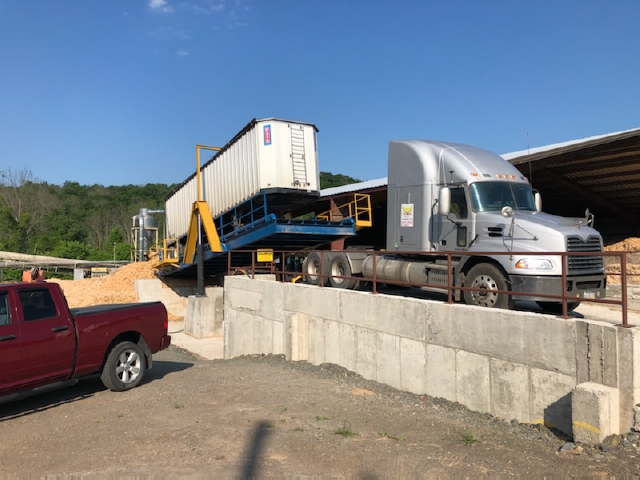
Wet chips in winter do not unload like dry hog fuel in July. That is where biomass truck unloading systems either earn their keep or create daily bottlenecks. For facilities handling wood waste, bark, mulch, pellets, agricultural residue, or mixed organic feedstocks, the unloading system has to do more than tip a trailer. It has to manage variable material behavior, truck traffic, safety exposure, throughput targets, and the realities of a working plant.
Biomass is rarely a uniform material stream. One day the load is stringy and bridged, the next it is saturated and compacted, and the next it carries frozen sections that resist movement until the trailer reaches a steeper angle. That variability is why many operations move away from improvised unloading methods and toward engineered hydraulic dumpers, tippers, hoppers, and receiving systems built for the actual material profile.
What biomass truck unloading systems need to solve
In a biomass application, unloading speed matters, but controlled material discharge matters just as much. If material hangs up in the trailer, operators lose time and often resort to unsafe intervention. If the receiving hopper is undersized or poorly matched to the dump geometry, material can spill, flood downstream equipment, or require additional cleanup labor.
A properly designed system has to address several conditions at once. It must lift and support the vehicle safely, create enough dump angle to release difficult loads, direct biomass into the receiving point without excessive spillage, and hold up under repetitive duty cycles. In many plants, it also has to fit inside existing civil constraints, traffic lanes, and process lines that were not originally laid out for modern high-volume unloading.
This is why biomass handling cannot be treated as a generic truck dumping problem. The equipment has to be selected around moisture content, bulk density, particle size, trailer type, desired tons per hour, and the operator's tolerance for downtime.
Common equipment used in biomass truck unloading systems
Most biomass facilities rely on one of several core unloading approaches, often paired with hoppers, metering equipment, and transfer conveyors. Hydraulic truck dumpers are a common choice where full trailers or trucks need to be elevated to discharge into a pit or hopper. Trailer tippers serve similar functions and are often matched to site traffic patterns, trailer dimensions, and unloading volume.
Container tippers are useful when the biomass arrives in detachable containers or specialized haul units. In applications where mobility or temporary deployment matters, semi-portable unloading equipment may provide a better fit than a fixed civil installation. The right choice depends on the transportation method as much as the material itself.
The receiving side is just as important as the lifting side. Hoppers need enough live capacity to accept peak discharge without choking the line. Their geometry should be designed to limit material buildup along sloped walls, especially with wet or stringy biomass. Downstream feeders and conveyors need to meter irregular material consistently so that the dumping cycle does not overwhelm the process.
Material behavior drives the design
Biomass varies more than many buyers expect. Wood chips can flow freely under some conditions and bridge under others. Bark can mat together. Ground green waste may carry oversized pieces that affect hopper clearance. Agricultural residue may be light and bulky, requiring larger containment volume than a denser feedstock moving at the same tonnage.
That means dump angle is not a minor detail. Some materials release cleanly at moderate elevation, while others require a steeper lift and a trailer floor condition that supports full discharge. Trailer construction also matters. Walking floor trailers, live-bottom units, open-top trailers, end dumps, and enclosed containers all create different unloading constraints.
An engineering-driven design process starts with the material, but it also checks the truck fleet. If carriers arrive with varying trailer lengths, axle configurations, and center-of-gravity characteristics, the dumping platform and restraint approach have to account for that range. Standard equipment may work in some operations, but high-variability biomass sites often need custom dimensions, higher capacities, or modified hopper interfaces.
Throughput, safety, and uptime are linked
Plant managers usually first focus on throughput. How many trucks per hour can the system unload, and how quickly can it return the vehicle to service? That is the right question, but it should not be separated from safety and maintenance.
When unloading is slow or unreliable, operators start making workarounds. Trucks wait longer in queue, loaders get pulled into cleanup duty, and personnel spend more time near suspended loads or active dump areas. A heavy-duty hydraulic system designed for the duty cycle reduces those friction points. Controlled lift, stable platform construction, and properly integrated receiving equipment help the unloading area run as a process, not as a daily exception.
Uptime comes from design discipline. Cylinders, pumping units, structural members, hinge points, controls, and safety interlocks all need to be sized for repeated industrial use. In biomass service, contamination, moisture, abrasion, and seasonal exposure increase the punishment on equipment. Underbuilt systems may perform acceptably during startup and then begin showing fatigue, alignment issues, hydraulic leakage, or inconsistent cycle times as production demands increase.
Where standard systems work and where custom engineering matters
Not every biomass facility needs a fully custom installation. If the material stream is relatively consistent, truck types are uniform, and the site has straightforward civil access, a standard dumper or tipper configuration may be the most efficient path. Standardization can reduce lead time, simplify spare parts planning, and make training more straightforward.
Custom engineering becomes more valuable when the site has unusual receiving elevations, restricted footprint, poor approach geometry, variable truck fleet dimensions, or difficult materials that do not discharge predictably. It also matters when the unloading system has to integrate with existing pits, conveyors, metering bins, dust control measures, or automation architecture.
For many industrial buyers, the decision is not standard versus custom in absolute terms. It is more often a standard heavy-duty platform with targeted modifications. That may include a different deck length, higher side containment, a larger hopper opening, reinforced wear areas, specialized controls, or a hydraulic package tuned to the required duty cycle.
Key considerations before specifying a system
The most effective projects begin with operational detail, not just equipment dimensions. Buyers should define the actual material range, including best-case and worst-case conditions. Moisture swings, freezing conditions, contamination, and load inconsistency all affect unloading performance.
Truck data should be documented with the same discipline. Overall vehicle length, trailer style, loaded weight, axle spacing, and unloading frequency influence platform design and system capacity. If outside haulers are part of the supply chain, there should be some allowance for variation instead of assuming a perfectly uniform fleet.
Site layout can decide the entire equipment approach. Available grade, pit depth, stormwater exposure, traffic stacking space, and access for maintenance all shape the final design. Controls and operator interface also deserve attention. A system may be mechanically sound but still lose productivity if the controls are awkward, visibility is poor, or fault recovery is cumbersome.
Maintenance planning should be part of procurement, not an afterthought. Hydraulic access, structural inspection points, wear liners, hose routing, and replacement cylinder strategy all affect long-term ownership cost. Industrial buyers know that a lower upfront price is not a savings if the equipment creates chronic downtime.
Why U.S.-built manufacturing control matters
For capital equipment that handles high-cycle industrial unloading, manufacturing control affects quality in practical ways. Fabrication tolerances, weld quality, hydraulic integration, structural reinforcement, and testing discipline all show up later in equipment life. That is especially true for large dumpers and tippers operating in abrasive, wet, and unpredictable biomass environments.
American International Inc operates in this space with a focus on heavy-duty hydraulic unloading equipment, in-house manufacturing control, and application-specific design. For buyers evaluating long-service assets, that combination matters because it supports both initial fit and long-term supportability.
Biomass truck unloading systems are only as good as their application fit
The best system is not the one with the highest lift or the fastest quoted cycle time. It is the one that unloads your material, with your truck mix, in your site conditions, without turning operators into problem-solvers every shift. Biomass truck unloading systems should be evaluated as part of the plant's material flow, safety profile, and maintenance strategy, not as isolated pieces of steel and hydraulics.
If a facility gets the specification right, unloading becomes predictable. Trucks move through faster, receiving areas stay cleaner, downstream equipment sees more consistent feed, and maintenance teams spend less time correcting design compromises. That is the kind of performance improvement that holds up long after installation, which is what serious industrial equipment is supposed to do.

