


How Hydraulic Truck Tipper Systems Work
June 4, 2026
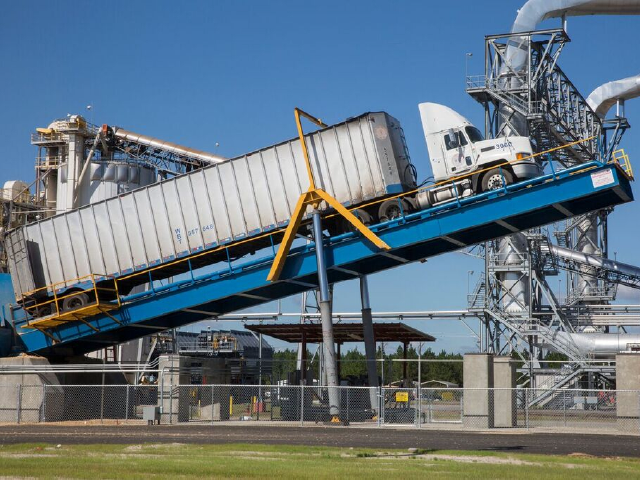
A truck backed into an unloading bay can either keep production moving or bring the line to a stop. The difference often comes down to how well the unloading equipment matches the material, vehicle, and operating environment. Hydraulic truck tipper systems are built for that exact point in the process - where throughput, safety, and equipment durability all meet under load.
For industrial operators handling wood waste, recyclables, aggregates, agricultural products, sludge, scrap, or other bulk materials, the tipping system is not just a piece of support equipment. It is a production asset. If the platform, cylinder package, hydraulic power unit, and controls are not engineered as one system, unloading becomes slower, harder on equipment, and less predictable from one load to the next.
What hydraulic truck tipper systems do
Hydraulic truck tipper systems raise an entire truck, trailer, or containerized load to a controlled angle so material can discharge by gravity into a hopper, bunker, or receiving area. The goal is straightforward: unload faster, reduce manual intervention, and maintain better control over a wide range of material types.
That sounds simple until real operating conditions are considered. Material does not always flow cleanly. Some products bridge, hang up, or shift suddenly. Vehicle dimensions vary. Site layouts limit approach angles, pit depth, and overhead clearance. In many facilities, the tipper has to perform every shift, in all weather, with minimal downtime. That is why serious industrial applications require more than a generic lift table with a cylinder attached.
Main components of hydraulic truck tipper systems
At the center of hydraulic truck tipper systems is the structural platform. This deck supports the full live load of the vehicle and payload during the lifting cycle. Heavy-duty fabrication matters here because the platform sees repeated stress, impact loading, and uneven distribution across axles. The frame design has to manage those forces without excessive deflection or fatigue over time.
The lifting action is typically generated by one or more hydraulic cylinders, often telescopic cylinders in higher-travel applications. Cylinder selection depends on lift height, tipping angle, platform geometry, load center, and cycle demands. A system that is undersized may struggle under peak loads. A system that is oversized without proper control can create unnecessary stress, energy use, or abrupt motion.
The hydraulic power unit supplies the force needed to raise and lower the platform. Pump capacity, reservoir sizing, motor selection, valve configuration, and pressure settings all affect response, cycle speed, and thermal performance. In demanding duty cycles, heat management and fluid cleanliness are not secondary details. They directly influence component life and system reliability.
Controls complete the system. Depending on the application, that may include simple operator stations or more integrated control packages with sequencing, interlocks, position monitoring, and emergency stop functions. For facilities with strict safety procedures, controls often need to coordinate with wheel restraints, traffic signals, or downstream handling equipment.
Why application-specific engineering matters
Two facilities may both ask for hydraulic truck tipper systems, but the correct solution can look very different from one site to the next. A plant unloading dry grain from highway trailers has different demands than a recycling operation receiving mixed loads with unpredictable flow characteristics. A forestry site handling wet wood chips has different wear and discharge issues than a waste processing facility dealing with dense, sticky material.
This is where engineering discipline matters. Material characteristics affect required tipping angle, hopper interface, and discharge control. Vehicle fleet consistency affects deck length, restraint design, and load positioning. Throughput targets influence cycle time expectations and hydraulic package sizing. Site constraints may dictate pit-mounted, above-grade, or semi-portable configurations.
A standard design can be the right answer when the application is repeatable and well understood. In tougher unloading environments, customization usually pays for itself by reducing blockages, limiting operator workarounds, and improving long-term reliability. American International Inc operates in that space where custom-engineered systems are often necessary because real facilities rarely match textbook conditions.
Safety is built into the system, not added later
When a loaded vehicle is elevated, safety cannot depend on operator judgment alone. The equipment itself has to support stable, repeatable operation. That starts with structural integrity and proper load path design, but it extends well beyond the steel package.
Hydraulic truck tipper systems should be evaluated for platform stability, anti-slip deck surfaces where appropriate, vehicle positioning features, wheel chocks or restraints, controlled lowering, and emergency stop capability. The control logic should reduce the chance of unsafe movement, especially during approach, loading confirmation, and descent.
There is also a practical side to safety that gets overlooked. If unloading is inconsistent, operators tend to improvise. They may reposition vehicles repeatedly, attempt partial discharge cycles, or manually intervene around hung material. A properly engineered tipper system reduces those situations. Better flow control and more predictable cycles contribute to a safer operation just as much as any single safety device.
Performance factors that affect real-world results
Buyers often focus first on rated capacity, and that is necessary, but capacity alone does not define performance. The more useful question is how the system performs over years of actual production.
Cycle time matters when truck traffic is high, but faster is not always better. A controlled lift profile may be preferable to a more aggressive one if it protects the structure, reduces load shift, and improves discharge consistency. Tipping angle is another key variable. Some materials unload cleanly at moderate angles, while wet, compacted, or irregular material may require significantly more elevation.
Maintenance access should also be part of the initial evaluation. Hydraulic truck tipper systems work in dusty, abrasive, and high-use environments. Service points, hose routing, cylinder access, and power unit layout all influence how easy the system is to maintain. Equipment that is difficult to inspect usually gets inspected less often, and that eventually shows up as downtime.
Durability depends on fabrication quality, cylinder construction, hydraulic component selection, and how well the design matches the duty cycle. Repetitive industrial unloading is not a light service application. The equipment should be built accordingly.
Common use cases for hydraulic truck tipper systems
These systems are widely used wherever bulk materials arrive in vehicles that need fast, controlled discharge. In agriculture, they support unloading of grain, feed ingredients, and other loose commodities. In forestry and biomass operations, they are commonly used for wood chips, bark, and residual fiber products.
Recycling and waste operations often rely on hydraulic truck tipper systems for mixed recyclables, organic material, processed waste streams, and other inconsistent loads that benefit from elevated discharge into hoppers or transfer systems. Industrial processors use them to feed sorting lines, storage bins, shredders, and conveyors while reducing manual handling.
The application details change, but the operational objective is usually the same: move material out of the truck quickly, safely, and with minimal interruption to upstream and downstream processes.
How to evaluate a system before purchase
A serious evaluation starts with the material. Bulk density, moisture content, particle size, tendency to bridge, and contamination level all influence system design. The next step is understanding the vehicles involved, including overall dimensions, axle layout, gross load, and variability from one truck to another.
From there, site conditions come into focus. Available space, foundation requirements, hopper geometry, approach grade, utility access, and environmental exposure all shape the final equipment package. It is also worth clarifying operating goals early. Some facilities need maximum throughput. Others prioritize flexibility across different loads, or reduced labor at the unloading point.
An experienced manufacturer should ask detailed questions in these areas. That is usually a good sign. Hydraulic truck tipper systems that perform well over time are rarely selected from a catalog page alone. They are specified around the realities of the operation.
The best result is a system that fits the facility, not one that forces the facility to adapt around it. When the steel structure, hydraulic package, controls, and material flow requirements are engineered together, unloading becomes more predictable and easier to manage shift after shift. That is where tipper systems deliver their real value - not only in lifting capacity, but in dependable performance where production cannot afford hesitation.

