


Trailer Tilter for Unloading: What to Know
June 5, 2026
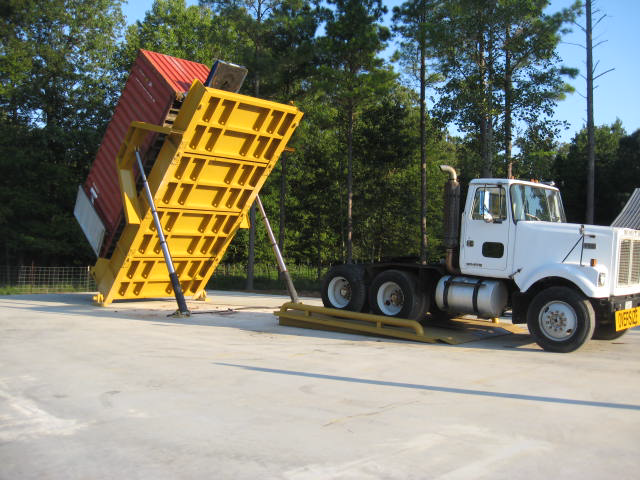
A trailer backed into position with wet wood chips, compacted recyclables, or irregular biomass can turn a routine unload into a bottleneck fast. In those situations, a trailer tilter for unloading is not just a convenience. It is often the difference between controlled material discharge and repeated delays, manual intervention, and avoidable equipment strain.
For industrial operators moving bulk solids at scale, the real question is not whether tilting equipment can unload material. It is whether the system is engineered for the trailer types, material behavior, throughput demands, and site conditions that define daily production. That is where equipment selection becomes an operational decision rather than a simple purchase.
What a trailer tilter for unloading actually does
A trailer tilter for unloading raises one end of a trailer to create a controlled incline, allowing gravity to assist material discharge. The trailer may remain attached to the tractor in some applications, or the unloading setup may be designed around detached trailer handling, depending on site workflow and equipment configuration.
This approach is especially effective where bulk materials do not discharge cleanly through standard walking floor, live bottom, or manual cleanout methods. Materials such as bark, compost, green waste, scrap, sludge cake, agricultural products, and light demolition debris can bridge, cling, or hang up inside the trailer body. A properly designed tilter changes the unloading angle enough to improve flow while reducing the need for personnel to enter or manually clear the trailer.
The value is straightforward. More complete discharge reduces cycle times, lowers labor exposure, and helps downstream systems receive material at a more predictable rate. But performance depends heavily on how the tilter is built and integrated.
Where trailer tilters make the biggest operational impact
In many facilities, the unloading point dictates upstream efficiency. If incoming trailers queue because material does not release consistently, the problem spreads beyond receiving. Processing lines starve or surge, labor gets reassigned to cleanup, and haul assets spend more time waiting than moving product.
A trailer tilter for unloading is often most valuable in operations handling difficult bulk materials with variable moisture content, inconsistent particle size, or seasonal changes in flowability. Forestry operations see this with bark and chips. Recycling plants deal with mixed loose materials that settle and compact in transit. Agricultural and organics facilities often receive loads that behave differently from one day to the next based on temperature and moisture.
There is also a strong safety case. Manual methods used to encourage discharge, including impact loading, climbing, or improvised clearing, introduce risk that can often be reduced with a purpose-built hydraulic tipping system. For many buyers, that risk reduction matters as much as raw throughput.
Key design factors in a trailer tilter for unloading
Tilt angle gets the most attention, but it is only one part of the design. The more important question is whether the machine has been engineered around actual trailer geometry, load characteristics, and operating conditions.
Trailer dimensions and load distribution
Trailer length, axle placement, frame strength, and center of gravity all influence system design. A tilter sized for one trailer style may not safely or efficiently handle another. Variations in trailer construction can affect support points, restraint requirements, and the way the load shifts during elevation.
This is why application review matters. Buyers should expect the equipment manufacturer to evaluate trailer type, typical gross weight, material density, and how consistently the load is distributed. A system handling lightweight mulch behaves differently from one unloading dense, wet aggregate fines or sludge-containing material.
Hydraulic capacity and structural strength
The hydraulic system has to lift under real-world conditions, not ideal ones. That includes cold starts, uneven loading, repeated cycles, and long-term wear. Cylinder sizing, power unit design, control logic, and hose routing all contribute to reliability.
Structural capacity matters just as much. A heavy-duty trailer tilter for unloading should be designed for repeated industrial cycles with appropriate reinforcement in high-stress areas. Fatigue resistance, weld quality, deck support design, and frame rigidity are not abstract engineering details. They directly affect service life, maintenance frequency, and safety margin.
Material behavior at discharge
Some materials begin flowing as soon as the trailer reaches a modest incline. Others remain bridged until the angle becomes much steeper, then release suddenly. That difference affects hopper sizing, impact zones, guarding, and downstream feed control.
A good system design accounts for what happens after the material starts moving. If the receiving hopper is undersized or the transition chute is poorly designed, the tilter may solve one bottleneck only to create another. The unloading system should be evaluated as a complete process, not as a standalone lift table.
Matching the tilter to the receiving system
Most unloading problems are system problems. The trailer tilter, hopper, controls, and downstream conveyor or processing line have to work together.
If the facility needs surge capacity, hopper volume becomes critical. If dust is a concern, enclosure and containment features may need to be built into the unloading station. If operators are handling several trailer configurations, controls and restraints may need added flexibility. In high-volume operations, cycle time between trucks can justify automation features that would be unnecessary at lower throughput sites.
This is where standard equipment sometimes falls short. A fixed platform may be adequate for predictable loads and uniform trailers, but demanding applications often require custom engineering around approach geometry, side containment, discharge height, or site-specific civil constraints. American International Inc operates in this part of the market, where the equipment has to fit the application instead of forcing the application to fit the equipment.
Safety considerations that should not be treated as add-ons
Industrial buyers already know that unloading equipment must do more than move material. It has to control risk during loading, positioning, tipping, and discharge.
For a trailer tilter for unloading, safety starts with stable platform design and positive trailer restraint. From there, the details matter. Operator control stations need clear sightlines or camera support. Hydraulic systems need proper load holding capability. Mechanical stops, interlocks, emergency stop functions, and safe access for maintenance should be part of the engineered package, not field improvisations.
Site layout also affects safe operation. Trailer approach alignment, wheel guidance, pedestrian separation, and housekeeping around the unloading zone all influence incident potential. A well-designed tilter can improve safety significantly, but only when it is installed as part of a disciplined operating environment.
Maintenance and lifecycle performance
Capital equipment decisions in this category are rarely driven by purchase price alone. The more useful metric is lifecycle value under production conditions.
A trailer tilter operating in a harsh industrial environment should be built for maintainability. That includes accessible hydraulic components, practical service points, replaceable wear areas, and a control system that plant personnel can troubleshoot without excessive complexity. Overbuilt equipment is not always the right answer, but underbuilt equipment is almost always expensive in the long run.
Buyers should also consider parts support and fabrication quality. Domestic manufacturing can provide advantages in lead times, replacement components, and application-specific modifications over the life of the machine. For plants that cannot afford long outages, those factors carry real weight.
When standard is enough and when custom is the better path
There are cases where a standard trailer tilter is appropriate. If trailer sizes are consistent, material flow is predictable, and site conditions are straightforward, a standard platform can provide solid value with shorter delivery and simpler implementation.
Custom engineering becomes more important when the operation handles multiple trailer types, difficult materials, unusual discharge heights, severe duty cycles, or constrained site layouts. It also matters when the tilter must integrate with hoppers, feeders, conveyors, or portable unloading systems already in place.
That trade-off comes down to risk. Standard equipment can reduce upfront cost and lead time, but custom design can reduce operational compromise. For many industrial facilities, the right answer depends on how expensive downtime, incomplete unloading, and workarounds have become.
Evaluating a trailer tilter for unloading before you buy
The best equipment discussions start with operating data. Trailer specs, material type, load weights, unload frequency, desired cycle time, and receiving system requirements should all be defined early. Photos and measurements help, but actual application details are what allow an equipment manufacturer to engineer for reliability instead of guessing.
It is also worth asking how the system will behave on a bad day. What happens with a frozen load, an off-center load, or a trailer that arrives less uniformly packed than expected? Those edge cases often reveal whether the design is truly industrial grade.
A trailer tilter for unloading is a practical piece of equipment, but it sits at a critical point in the process. When it is properly engineered, it can improve throughput, reduce labor exposure, and make bulk receiving more predictable across a wide range of materials. When it is undersized, poorly integrated, or selected without enough application review, it simply moves the problem downstream.
The right solution starts with a clear look at how your material actually behaves when the trailer door opens, because that is where engineering stops being theoretical and starts paying for itself.

